
Few things spike your heart rate faster than watching your dashboard warning lights come on while you’re doing 70mph on the M6, or feeling your car lose power just as you merge onto the M5 near Longbridge. Motorway breakdowns are stressful — but they’re also one of the most dangerous situations an ordinary driver can face. Every year, people are seriously injured or killed simply because they didn’t know the right steps to take in the first two minutes after their car stopped.
This guide walks you through exactly what to do if you break down on the M6, M5, M42 or any other motorway around Birmingham — the safety steps, the common mistakes, what “smart motorways” change about the rules, and how to get help quickly without putting yourself at risk. Whether you’re commuting through Coleshill, heading south past Longbridge, or crossing the M42 near Marston Green, this is the guide to save, bookmark, or read again if you’re ever in this situation.
Why Motorway Breakdowns Are More Dangerous Than You Realise
A car park breakdown is an inconvenience. A motorway breakdown is a genuine hazard — for you, your passengers, and everyone else on the road.
Motorway traffic moves at speeds most people never experience anywhere else in daily life. A vehicle travelling at 70mph covers over 30 metres every second, which means the gap between “driver notices a stationary car” and “driver reacts” can be the difference between a near-miss and a serious collision. Add poor visibility, rain, darkness, or a driver glancing at their phone, and a stranded vehicle on the hard shoulder — or worse, in a live lane — becomes one of the highest-risk situations in UK driving.
This is exactly why the Highway Code devotes specific rules to motorway breakdowns, and why organisations like National Highways run ongoing safety campaigns about what to do if you get into difficulty. If you take one thing from this article, let it be this: get out of the vehicle and away from the carriageway as quickly and safely as you can. Everything else is secondary to that.
Common Reasons Drivers Break Down on the M6, M5 and M42
Understanding why breakdowns happen can help you avoid one in the first place. The most frequent causes we see when we recover vehicles from motorways around Birmingham include:
- Flat or failing batteries — especially in older vehicles or after a car has sat unused for a few days.
- Tyre blowouts — worn tread or incorrect pressure under sustained high speed is a common trigger, particularly on the fast-moving stretches of the M6 near Castle Bromwich and Coleshill.
- Overheating engines — low coolant or a failed water pump, more common in stop-start traffic around the M5/M6 interchange.
- Running out of fuel — surprisingly common on long stretches with fewer service stations.
- Timing belt or mechanical failure — sudden and often with little warning, particularly in vehicles overdue a service.
- Accident damage — a collision or a piece of road debris that makes the car unsafe to drive further.
If your car has been showing warning signs — a dashboard light, a strange noise, sluggish acceleration — for more than a day or two, treat it as a warning rather than something to put off. A five-minute check before a motorway journey is far cheaper than a breakdown truck at rush hour.
Step-by-Step: What to Do If You Break Down on the Motorway
If it does happen, don’t panic — follow these steps in order.
1. Get your car off the live lanes if you possibly can
If your vehicle still has some power and control, indicate and move calmly across to the hard shoulder or the nearest exit slip road. Don’t attempt anything sudden or risky — a controlled, gradual move to the left is always safer than a last-second swerve.
2. Put your hazard lights on immediately
This should be the very first thing you do once you realise there’s a problem, even before you’ve fully stopped. It warns traffic behind you that something isn’t right.
3. Pull as far left as possible
On a standard hard shoulder, get your wheels turned towards the verge and stop as close to the barrier or embankment as you safely can. This maximises the gap between your car and live traffic.
4. Exit through the passenger-side doors only
This is one of the most overlooked rules. Never get out on the traffic side of the vehicle. Passengers, including children and pets, should exit from the left-hand doors and move well away from the road.
5. Get behind the barrier
Stand behind the safety barrier, well away from the hard shoulder itself, and as far up the verge as the terrain allows. Do not stand next to your vehicle, and do not attempt any repairs yourself.
6. Do not use a warning triangle on the motorway
Unlike a country road breakdown, you should never walk back into the carriageway to place a warning triangle on a motorway. It isn’t worth the risk.
7. Call for help
Use a mobile phone if you have signal, or one of the free roadside emergency phones (marked by blue signs with an arrow pointing to the nearest one) which connect directly to National Highways. Give them your location — the small numbered marker posts along the verge tell them exactly where you are.
8. Keep pets and children calm and contained
If you’re travelling with children or animals, keep them close, calm, and away from the edge of the barrier until help arrives.
9. Stay alert while you wait
Keep watching oncoming traffic. If a vehicle appears to be heading towards your position, be ready to move further away or climb the embankment if there is one.
Smart Motorways: What Changes If There’s No Hard Shoulder
Sections of the M6 and M42 around the West Midlands include “smart motorway” stretches where the hard shoulder has either been permanently converted into a running lane or is only used at certain times. This changes what you need to do if you break down:
- Look for an Emergency Refuge Area (ERA) — a marked lay-by set slightly off the carriageway. Try to reach one if you’re able to keep the car moving safely.
- If you can’t reach an ERA and you’re stuck in a live lane, keep your seatbelt on, put your hazard lights on, and stay inside the vehicle with your seatbelt fastened unless you can safely and immediately get out on the passenger side and behind a barrier.
- Look overhead for a red X on the gantry signs — this means the lane is closed and traffic should not be using it. An amber SOS or reduced speed signal is often triggered automatically once your hazard lights are detected or reported.
- Call National Highways or dial 999 if you’re in a live lane with no way to reach a refuge area — this is treated as an emergency.
Smart motorways are one of the most misunderstood parts of UK breakdown safety, and getting this wrong is genuinely life-threatening. If you’re unsure whether a stretch of the M6 or M42 you regularly drive is a smart motorway section, it’s worth checking before you need to know.
Common Mistakes That Make a Bad Situation Worse
We see the same avoidable mistakes again and again when recovering vehicles from motorways around Birmingham:
- Staying inside the vehicle on the hard shoulder. Once you’re safely out, stay out — don’t go back in to get belongings or stay warm.
- Standing between your car and the traffic. Always position yourself on the verge side, behind the barrier where one exists.
- Trying to fix the problem yourself on the hard shoulder. Changing a tyre or checking under the bonnet next to live traffic is far riskier than waiting for a recovery vehicle.
- Walking along the hard shoulder to find help. Stay near your vehicle unless there’s a genuine safety reason to move.
- Not knowing your location. Look for the small marker posts on the verge — they show the road number and distance, which speeds up the response time enormously.
- Panicking about cost before safety. Get yourself safe first. Sort out recovery second.
How Blue Light Car Recovery Services Helps When You Break Down Near Birmingham
Once you’re safe and off the carriageway, the next step is getting your vehicle recovered quickly, safely, and without a nasty surprise on the bill. That’s where we come in.
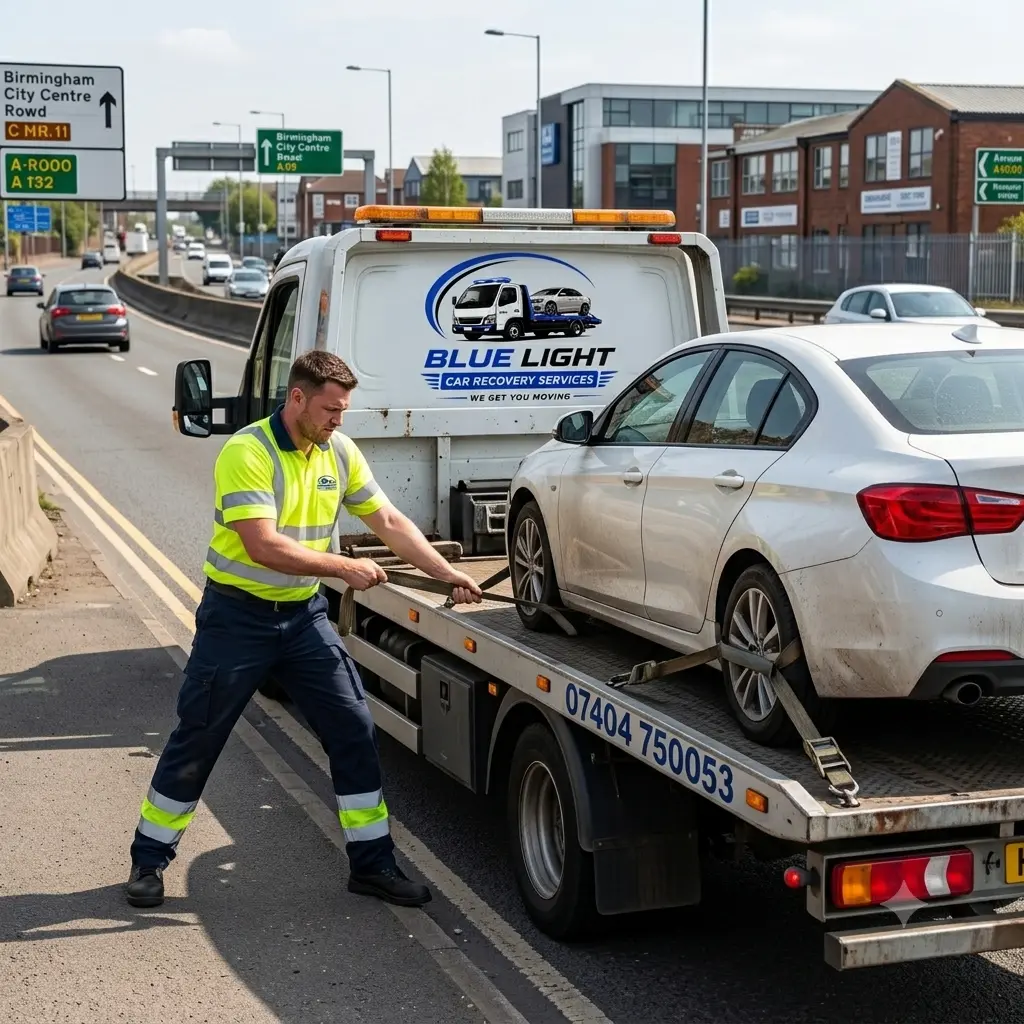
Blue Light Car Recovery Services has spent over ten years recovering vehicles from the motorways, A-roads and side streets around Birmingham. We offer:
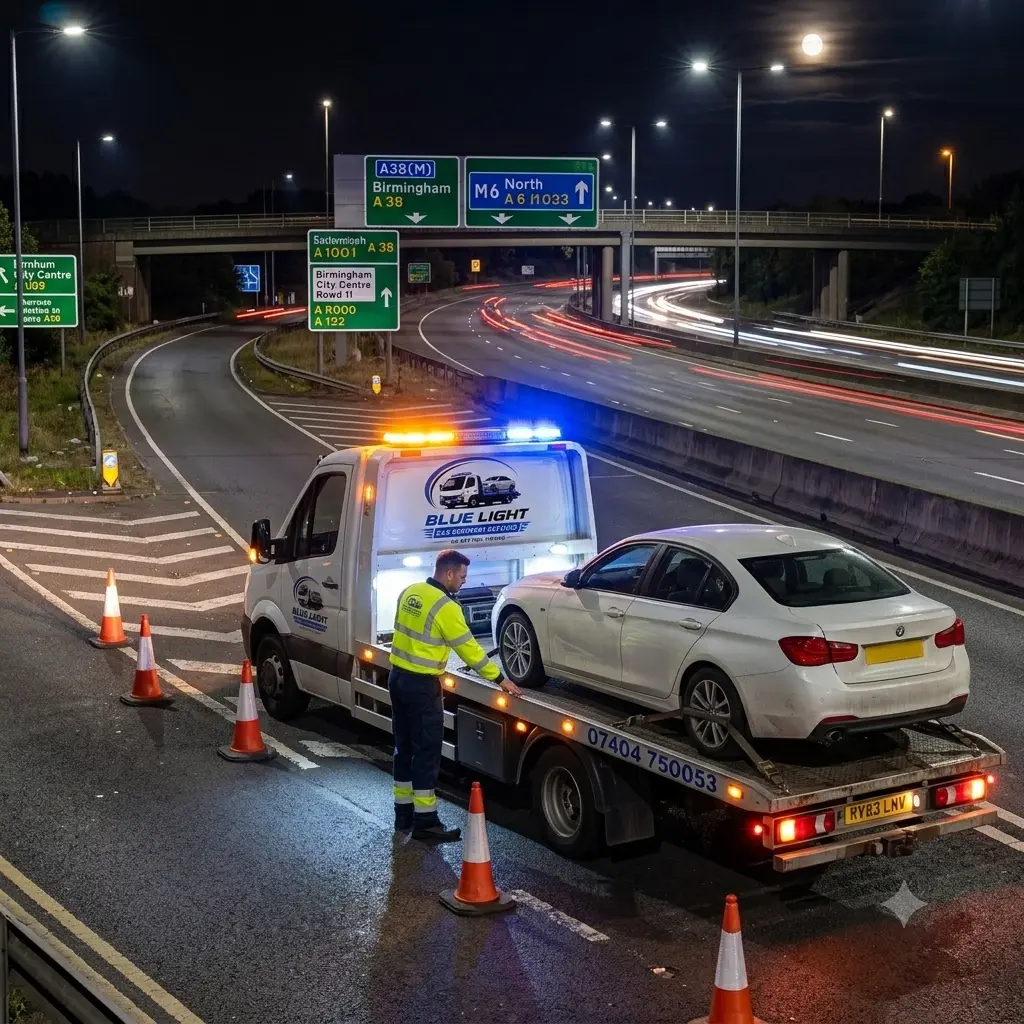
- Emergency roadside assistance for breakdowns on the M6, M5, M42 and every road in between — 24 hours a day, 365 days a year.
- Breakdown recovery with a fixed price agreed before we set off, so there’s no shock invoice after a stressful day.
- Accident recovery with careful scene clearance if your breakdown was the result of a collision.
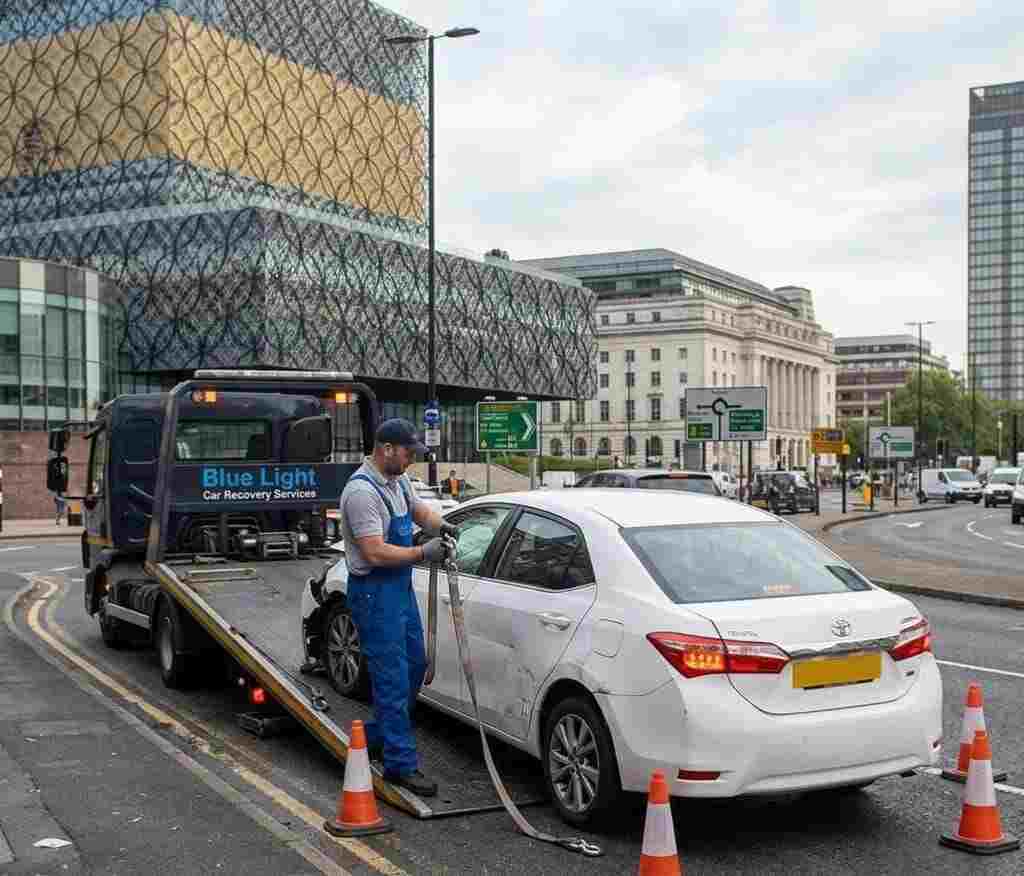
- Car towing and vehicle transport to your home, a trusted garage, a dealership, or anywhere else you need your car delivered.
- Junk car towing if your motorway breakdown turns out to be the final straw for an older vehicle.
Unlike national membership schemes, you don’t pay an annual fee whether you break down or not — you call us when you actually need us, we agree a fixed price up front, and our own local truck (not a subcontractor from another county) comes straight to you. You can read more about how the whole process works in our complete car recovery guide for Birmingham, or find out what actually separates a “car,” a “vehicle,” and a “breakdown” service if you’re comparing providers.
Areas We Cover Near the M6, M5 and M42
Because our base is right here in Birmingham, we’re regularly first on scene at motorway breakdowns near these areas — all covered 24/7 with the same fixed-price promise:
Coleshill (M6/M42 junction), Castle Bromwich, Chelmsley Wood, Marston Green, Erdington, Sutton Coldfield, Perry Barr, Great Barr, Kingstanding, Longbridge, Rubery, Northfield, Selly Oak, Quinton, Bartley Green, Weoley Castle, Woodgate Valley, Kings Norton, Streetly, and Walmley.
Not on this list? We cover the whole of Birmingham and the surrounding motorway network — see our full service area page or get in touch and we’ll confirm we can reach you.
Frequently Asked Questions
Is it illegal to stay in your car on the motorway hard shoulder?
It isn’t illegal, but National Highways strongly advises against it. Get out on the passenger side and stand behind the barrier whenever it’s safe to do so.
What number do I call if I break down on a smart motorway with no hard shoulder?
Call 999 immediately if you’re stuck in a live lane and cannot reach an Emergency Refuge Area. This is treated as an emergency, not a standard breakdown call.
How long does motorway recovery usually take?
Response times depend on location and traffic, but our local Birmingham base means we’re often faster to M6, M5 and M42 breakdowns near the city than a national provider dispatching from further away.
Will I be charged extra for a motorway breakdown compared to a home breakdown?
With Blue Light Car Recovery Services, you get one clear, fixed price agreed before we set off — regardless of the time of day, the location, or how far the recovery is within our coverage area.
What should I do with my pet or child while waiting for recovery on the motorway?
Keep them with you behind the barrier, away from the hard shoulder, calm and contained until the recovery vehicle arrives. Never leave them alone in the car once you’ve evacuated it.
Can you recover my car from the motorway and take it straight to a garage?
Yes — just tell us the destination when you call, whether that’s your home, a garage, a dealership, or a scrapyard, and it’s included in your fixed quote. See our vehicle transport service for details.
Final Word
A motorway breakdown will always be stressful, but it doesn’t have to be dangerous. Hazard lights on, pull left, exit on the passenger side, get behind the barrier, and call for help — that sequence, done calmly, is what actually keeps you safe. Everything after that, from the tow truck to the paperwork, is something we can take care of for you.
If you break down on the M6, M5, M42 or anywhere else around Birmingham, Blue Light Car Recovery Services is available 24/7 with a fixed price and no call-out fee. Book an appointment online, read more about who we are, or browse our full range of services — and stay safe out there.